





Seeing Shapes
Grades: PK-1
Seeing Shapes
Students learn about 2-dimensional shapes and create a class book identifying these shapes around their school.
Engage
Introduce different 2-dimensional shapes to your students. Show students examples of squares, circles, rectangles, and triangles, and work with them to count the sides and identify them.
Read a story like The Greedy Triangle by Marilyn Burns or The Shape of Me and Other Stuff by Dr. Seuss to get students thinking about shapes in the world around them.
Ask students to look around your classroom to find objects of a particular shape, like a circle or square, and to name the shapes they see. For example, the tables or desks in the room are probably rectangles; the clock is likely to be a circle.
Assign the Find Shapes activity to provide more practice finding shapes in the real world.
Create
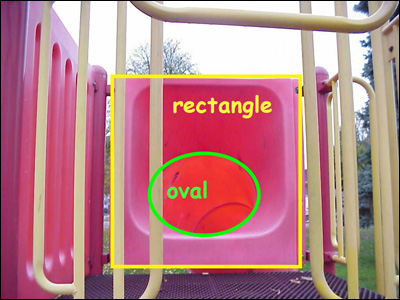
Take a walk around your school, looking for additional shapes in the environment; playground equipment is a great place for students to find these shapes. Capture images of the shapes you find.
You can collect the images and put them in a single project that you can assign to the students in your class so they can identify the shapes in the pictures.
Have students use paint or drawing tools to identify the shape on the page. Then, have them record their voice, identifying the shape, and explaining more about it. You may also want students to describe the shapes location using position words such as on top of, next to, and so on.
Have more advanced students identify complex shapes such as rhombuses and trapezoids, 3D shapes like cubes and spheres, or even acute and obtuse angles.
Share
If you have access to a printer, ask students to print their page or project so you can hang the images around the room as examples of different shapes students can find in the world around them.
If students create individual pages, combine them using the Project Wizard. Print copies of the book for students to share with their families. You can even use the booklet style to print four to a page and fold.
Standards for Math:
CCSS.CONTENT.K.G.A.1
Describe objects in the environment using names of shapes, and describe the relative positions of these objects using terms such as above, below, beside, in front of, behind, and next to.
CCSS.MATH.CONTENT.K.G.A.2.
Correctly name shapes regardless of their orientations or overall size.
CCSS.MATH.CONTENT.K.G.A.3
Identify shapes as two-dimensional (lying in a plane, “flat”) or three-dimensional (“solid”).
CCSS.MATH.CONTENT.2.G.A.1
Recognize and draw shapes having specified attributes, such as a given number of angles or a given number of equal faces. Identify triangles, quadrilaterals, pentagons, hexagons, and cubes.