





13 Days of Halloween
Grades: PK-2
The 13 Days of Halloween
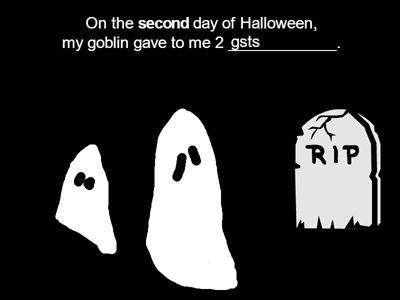
Goblins are coming, witches are getting out their brooms, and black cats are ready to cross your path... it must be close to Halloween! Have students practice counting by creating a Halloween book based on the popular "12 Days of Christmas" song, creating a page, or entire book, showing a specific number of Halloween objects "my goblin gave to me."
Engage
Start by reading Two Little Witches by Harriet Ziefert and Simms Taback to help students practice their counting skills, experience a repetitive story form, and get them thinking about characters associated with Halloween.
Work as a class to brainstorm a list of objects, and characters, they see at Halloween.
Create
Explain to students that they will create a page for a 13 Days of Halloween book that includes an illustration showing the specific number of Halloween characters based on the day. Students will also write or type the name of the object, the number of the objects on the page, and the ordinal number of the day in the 13 day sequence.
Have each student choose the Halloween object they wish to count on their page. Students can use the paint tools and Halloween clip art to quickly design illustrations. Have a parent, aide, or school buddy work with each student to draw the Halloween objects and write the numbers and object names.
You can also assign a template that includes 13 pages with text objects already on each page.
Share
Combine individual student pages together into a class book using the Project Wizard.
Share the book in its interactive form on your classroom website or present it from a local computer. You can also export the file as an ePub or PDF to send home with students to read with their families.
Resources
Ziefert, Harriet and Taback, Simms. Two Little Witches: A Halloween Counting Story. ISBN: 0763618942
Standards
Common Core Standards for Mathematics
Kindergarten: Counting and Cardinality
1. Count to 100 by ones and by tens.
3. Write numbers from 0 to 20. Represent a number of objects with a written numeral 0-20 (with 0 representing a count of no objects).
4. Understand the relationship between numbers and quantities; connect counting to cardinality.
5. Count to answer "how many?" questions about as many as 20 things arranged in a line, a rectangular array, or a circle, or as many as 10 things in a scattered configuration; given a number from 1-20, count out that many objects.
Common Core Standards for ELA
Reading: Speaking and Listening Theme
4. Present information, findings, and supporting evidence such that listeners can follow the line of reasoning and the organization, development, and style are appropriate to task, purpose, and audience.