






Spring into Fractions
Grades: 3
Spring Into Fractions
Students write and illustrate a spring-inspired short story that includes fractions they find in nature or their local community.
Engage
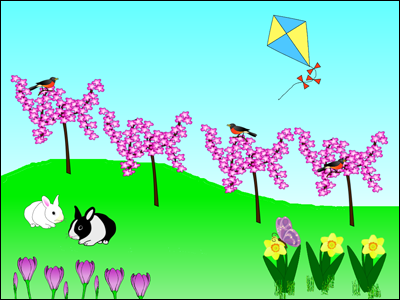
Ask students to share things they see in spring and record it so the entire class can see. Then, choose an example or two and represent it as fraction. For example, a daffodil has six leaves; a kite may have differently colored panels.
Read a story with fractions, like Full House: An Invitation to Fractions by Dale Ann Dodds and discuss how fractions are part of the story.
Create
Let your students know they will be creating a similar fraction story, using the spring season as the subject. Start by having students choose three spring objects or activities that can divided fractionally.
Assign the Four Boxes organizer and ask students to organize events in their story, including a simple picture that illustrates the fraction.
Have students begin writing a spring story that includes clear descriptions of color, size, and shape to help readers visualize the fraction.
Assign a blank canvas and ask students to use Wixie's tools to add text, pictures, and voice narration.
Pair students together to share their stories and get feedback they can use to edit , revise, and improve their stories.
Share
Print stories as booklets to fold and share with classmates and families. If students added narration, share the project URL or export their work as a PDF, eBook, or video.
Standards
Math Standards
3.NF.A.3.B Recognize and generate simple equivalent fractions, e.g., 1/2 = 2/4, 4/6 = 2/3. Explain why the fractions are equivalent, e.g., by using a visual fraction model.
English Language Arts Standards
3.W.3.3. Write narratives to develop real or imagined experiences or events using effective technique, descriptive details, and clear event sequences.
3.W.3.3.A. Establish a situation and introduce a narrator and/or characters; organize an event sequence that unfolds naturally.