






Suitcase Stories
Grades: 2-4
Suitcase Stories
Students create suitcase stories to describe an ancestor’s journey to America and important objects they might have packed.
Engage
Start with an overview of immigration, such as Betsy Maestro's Coming to America: The Story of Immigration. Scholastic also has a great Meet Young Immigrants collection of stories from real kids who have recently immigrated to the United States.
Ask families in your class if anyone has an immigration story they can share in person or over a video call. There is nothing quite like a personal story to help students better understand what it is like to immigrate.
Depending on your students' backgrounds, you may want to read and explore a variety of picture books that share immigrant experiences, such as:
- Grandfather’s Journey
- My Diary From Here to There/Mi diario de aqui hasta alla
- The Arabic Quilt: An Immigrant Story
Create
Have students ask their parents about their family's immigration story and share their initial discussion with the class. Be sure to write down any questions that arise as students share their stories. If students don't have questions during class discussions, give them time to reflect and write down "I wonder" questions on their own.
Then, work together to develop a short list of questions everyone should try to answer about their family's immigration story. Send the questions home with students so they can more clearly ask family members about their experiences.
Have students translate their notes and ideas into a paragraph or story about their ancestor’s journey. You can use sentence starters to support student writing, such as:
- “My ancestors came from __________________ (place).”
- “They packed ___________ because they wanted to _____________.”
- “On their journey, they _________.”
- “In this country, they _________.”
Have students turn their written story into a book, slideshow or video, using their writing as a script to record narration. Students can create a page for each idea and use paint tools and images to illustrate the story.
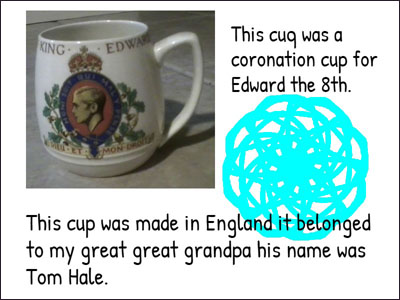
If your students immigrated recently, have them tell their personal story using an object they took with them.
Share
When student work is done, host a family movie night and showcase student stories for all to see and hear, or create an online gallery of student's work on your classroom webpage and share the URL to each student project with family members.
Standards
NCSS- National Council for Social Studies C3 Framework
Dimension 2: Geography
D2.Geo.7.3-5. Explain how cultural and environmental characteristics affect the distribution and movement of people, goods, and ideas.
D2.Geo.8.3-5. Explain how human settlements and movements relate to the locations and use of various natural resources.
D2.Geo.9.3-5. Analyze the effects of catastrophic environmental and technological events on human settlements and migration.