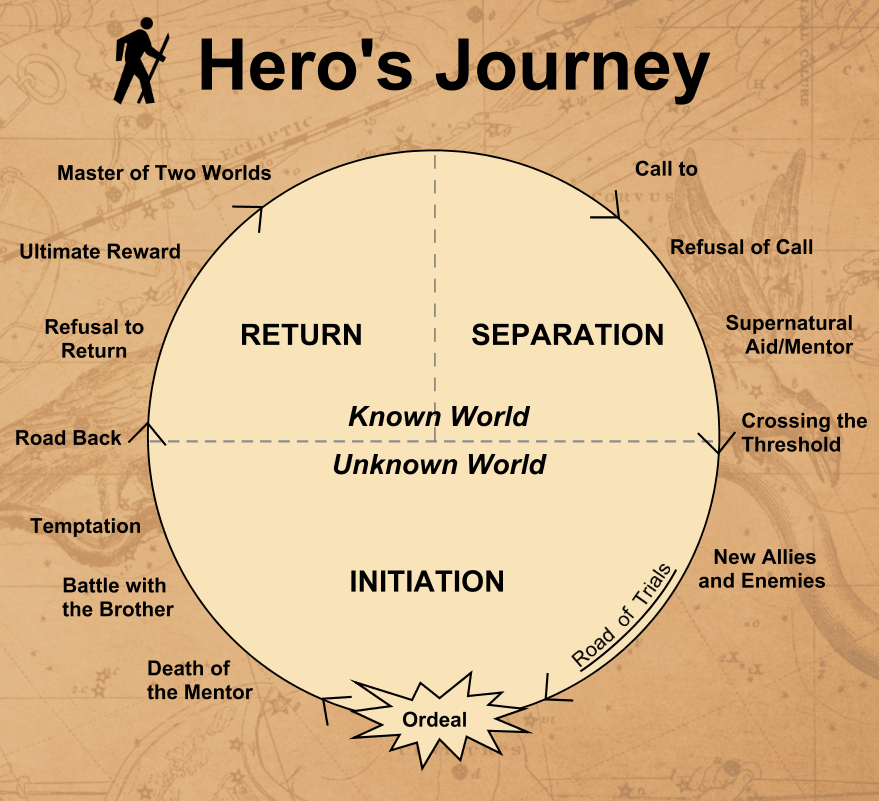







The Hero's Journey
Grades: 6-12
The Hero's Journey
After exploring mythology and the concept of the monomyth, students will create a digital book identifying and explaining the events in the hero's journey in a text they are reading.
Engage
Begin this project by asking your students to brainstorm a list of heroes, including comic book superheroes, movie heroes, and historical figures. Then, have students provide a summary for each hero and discuss the qualities of a hero.
- What makes them heroic?
- Their character traits?
- The things that happen to them?
- How do they respond to those events?
- All of the above?/li>
Ask students if they can identify similarities between the different heroes.
Introduce the idea of Joseph Campbell's monomyth, or hero's cycle, to your students. Campbell claims that most great heroes have taken the path of this hero's journey. Campbell's stages fall into three main areas of departure, initiation, and return, which are further broken down into 17 stages. Discuss the stages you want to use, such as:
Explore the hero cycle in Greek mythology using heroes like Hercules, Jason, Odysseus, Perseus, or Theseus. Discuss their journeys' stages and their connections to modern literature and entertainment. Show Matthew Winkler's TED-Ed video, What makes a hero?
Next, watch a modern movie together and analyze how it aligns with the monomyth. You can use completed analyses of movies like Shrek for inspiration or start fresh. Here are some popular movie options for various ages and backgrounds.
Introduce the first part of the cycle and have the students identify the major areas of the story that show the cycle. You may want to model strategies for close reading as you explore a written myth or sample together.
Create
Now it's time for students to practice close reading and identify the hero's journey in a different story.
Give students a list of books they can read to analyze for the monomyth. Assign individual students a story, depending on their reading and maturity level. Here are examples at different reading levels:
- A Wrinkle in Time by Madeleine L'Engle
- Dragonwings by Laurence Yep
- Harry Potter and the Sorcerer's Stone by J.K. Rowling
- Hunger Games by Suzanne Collins
- Mrs. Frisby and the Rats of NIMH by Robert O'Brien
- Percy Jackson and the Olympians by Rick Riordan
- The Dark is Rising by Susan Cooper
- The Lord of the Rings by J.R.R. Tolkien
- The Princess Bride by William Goldman
Students can use the Hero's Journey template to define each stage and identify it using examples from the text. They can add photos, images, and drawings to illustrate the event and record audio to summarize events.
If several students read the same book, have them share their work in small literature circles and discuss how they identified the stages.
Tobuild comprehension and narrative writing skills, ask students to write journal entries from the hero's perspective at each stage of the cycle. Encourage them to draw a scene of the event and then record their voice as they share details of the events.
Share
Have students present their findings to the rest of the class or with a partner. You might also have them present their work to another class to teach other students about the hero’s journey.
English Language Arts Standards - Grade 6
Reading: Literature
Key Ideas and Details
1. Cite textual evidence to support analysis of what the text says explicitly as well as inferences drawn from the text.
3. Describe how a particular story’s or drama’s plot unfolds in a series of episodes as well as how the characters respond or change as the plot moves toward a resolution.
Key Ideas and Details
5. Analyze how a particular sentence, chapter, scene, or stanza fits into the overall structure of a text and contributes to the development of the theme, setting, or plot.
Speaking and Listening
Presentation of Knowledge and Ideas
5. Include multimedia components (e.g., graphics, images, music, sound) and visual displays in presentations to clarify information.
Writing
Text Types and Purposes
3. Write narratives to develop real or imagined experiences or events using effective technique, relevant descriptive details, and well-structured event sequences.
Production and Distribution of Writing
6. Use technology, including the Internet, to produce and publish writing as well as to interact and collaborate with others; demonstrate sufficient command of keyboarding skills to type a minimum of three pages in a single sitting.