





Dream Room Design
Grades: 3-7
Dream Room Design
Students explore length, width, perimeter, and surface area, convert measurements, and work with 2-D representations of 3-D objects as they design their dream room.
Engage
Introduce the concepts of length, width, and perimeter to your students. Ensure that they know how to determine the surface area for simple rectangular shapes. Have them practice measurement skills in your classroom by determining the dimensions of your classroom and the objects in it.
Then, brainstorm with your class the elements a bedroom might have, such as a bed, dresser, and television:
- Which items are needs, and which are desires?
- What should a bedroom do for the occupant?
- If it contains a bed, do all beds have to be exactly the same?
Assign a cluster organizer for students to collect their ideas.
Create
Have students begin by creating a sketch of their dream room using a blank template. The designs should include major elements that make it obvious this is a bedroom.
You may also ask them to add architectural details such as power outlets, doors, windows, cable, and telephone access.
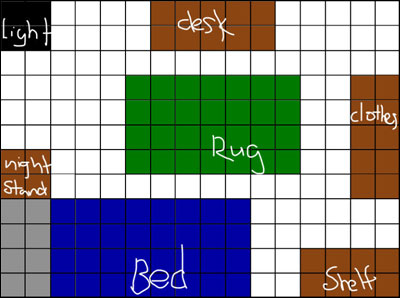
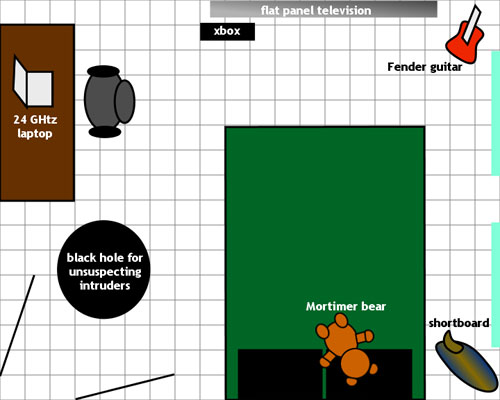
Once students have a general idea of their room's layout, have students complete their design to scale. They can create from a grid template to create accurate and appropriately sized representations of objects like rugs, dressers, beds, and desks.
Encourage them to develop a key for their design using shapes and colors with text descriptors for clarification. When their visual design is complete, have students add a page or pages that include a description of their dream room and its objects.
Share
Have students use the text in their descriptive essay and a picture of their dream room to share their design ideas with the rest of the class.
Return to your brainstorm about what makes a bedroom. Compare what the students have included in their designs to the elements they came up with on their list.
Resources
Hallam, Linda. Decorating Kids’ Rooms: Nurseries to Teen Retreats. ISBN: 069620729X.
Brunetto, Carolyn Ford. MathART Projects and Activities. ISBN: 0590963716
Common Core State Standards for Mathematics
CCSS.MATH.CONTENT.3.MD.C.5
Recognize area as an attribute of plane figures and understand concepts of area measurement.
CCSS.MATH.CONTENT.3.MD.C.7.A
Find the area of a rectangle with whole-number side lengths by tiling it, and show that the area is the same as would be found by multiplying the side lengths.
CCSS.MATH.CONTENT.3.MD.C.7.B
Multiply side lengths to find areas of rectangles with whole-number side lengths in the context of solving real world and mathematical problems, and represent whole-number products as rectangular areas in mathematical reasoning.
CCSS.MATH.CONTENT.7.G.A.1
Solve problems involving scale drawings of geometric figures, including computing actual lengths and areas from a scale drawing and reproducing a scale drawing at a different scale.
CCSS.MATH.CONTENT.7.RP.A.2
Recognize and represent proportional relationships between quantities.