





Soil - Diary of a Worm
Grades: 3-5
Soil - Diary of a Worm Campaign
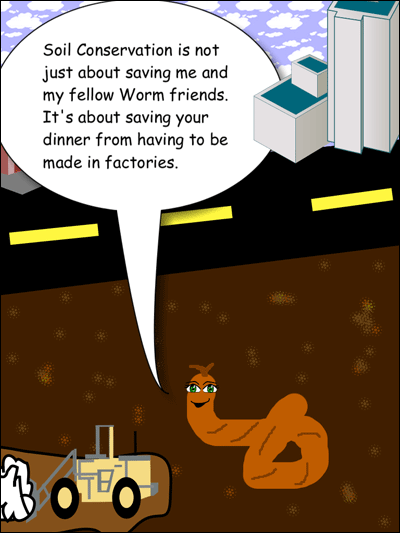
Students will investigate different types of soil. Using Diary of a Worm as inspiration, they will create a media campaign to educate others about the layers, components, and inhabitants of soil and explain why soil is beneficial.
Engage
There are many types of soil, each with its own unique characteristics and benefits. Bring different types of soil into your classroom as well as investigate different types of soil found around your school and community. Discuss the characteristics of each type of soil and document with pictures, descriptive words and research of uses, including the pros and cons of using specific soils for different purposes.
Students should be able to answer:
- What is soil?
- What are the layers of soil?
- What plants and animals depend on soil?
- How do we depend on those plants and animals?
- What are the benefits of soil?
Read Doreen Cronin's Diary of a Worm. Ask students to explain the benefits of soil and what role a worm plays in the ecosystem. Discuss the practice of paving over "dirt" to save money.
- What would be the result of the paving over the dirt?
- What alternatives used will make the “dirt” more valuable for everyone?
Discuss ways students could educate others about the benefits of soil, such as stories, brochures, public service announcements, or comics.
Create
Form small teams of students and have them list the stories, facts, and ideas they think will be helpful in making a successful argument. Teams should review their notes, complete additional research, and develop a plan for the product they will create to educate others.
Have teams share their proposals with the rest of the class. This allows all teams to benefit from all students’ thorough research, powerful facts, and creative ideas. Ask each team to choose one or two core arguments and begin determine how their team might best make the case to support their position, developing products such as presentations, bumper stickers, posters, public service announcements, children’s stories, brochures, comics, or graphic novels.
Students can use a blank canvas to develop their materials.
Share
Have students present their information to other students at school during an assembly or at a booth on the playground or in the cafeteria.
You might choose to share PSAs on your school web site or present them during morning announcements. You may also be to share the PSAs on your local access television station to help educate the community. Post student videos and web sites to your school web server or to a video sharing community for wider distribution. Brochures can be printed and distributed at local coffee shops and garden stores.
Resources
Cronin, Doreen. Diary of a Worm. ISBN: 043969745X
Rosinsky, Natalie. Dirt: The Scoop on Soil. ISBN: 1404803319
Bial, Raymond. A Handful of Dirt. ISBN: 0802786987
Soil Science Society of America
Standards
NSES - National Science Education Standards
Physical Science - CONTENT STANDARD B:
As a result of the activities in grades K-4, all students should develop an understanding of: Properties of objects and materials
Earth and Space Science
Content Standard D
As a result of their activities in grades K-4, all students should develop an understanding of: Properties of earth material
Common Core Anchor Standards for English Language Arts - Grade K-5
Reading Theme
Key Ideas and Details
1. Read closely to determine what the text says explicitly and to make logical inferences from it; cite specific textual evidence when writing or speaking to support conclusions drawn from the text.
Craft and Structure
4. Interpret words and phrases as they are used in a text, including determining technical, connotative, and figurative meanings, and analyze how specific word choices shape meaning or tone.
6. Assess how point of view or purpose shapes the content and style of a text.
Writing Theme
Text Type and Purpose
2. Write informative/explanatory texts to examine and convey complex ideas and information clearly and accurately through the effective selection, organization, and analysis of content.
Production and Distribution of Writing
4. Produce clear and coherent writing in which the development, organization, and style are appropriate to task, purpose, and audience.
Research to Build Present Knowledge
7. Conduct short as well as more sustained research projects based on focused questions, demonstrating understanding of the subject under investigation.
9. Draw evidence from literary or informational texts to support analysis, reflection, and research.
Range of Writing
10. Write routinely over extended time frames (time for research, reflection, and revision) and shorter time frames (a single sitting or a day or two) for a range of tasks, purposes, and audiences
Speaking and Listening Theme
Comprehension and Collaboration
2. Integrate and evaluate information presented in diverse media and formats, including visually, quantitatively, and orally.
Presentation of Knowledge and Ideas
4. Present information, findings, and supporting evidence such that listeners can follow the line of reasoning and the organization, development, and style are appropriate to task, purpose, and audience.