






Diary of a Snowflake
Grades: 2-4
Diary of a Snowflake
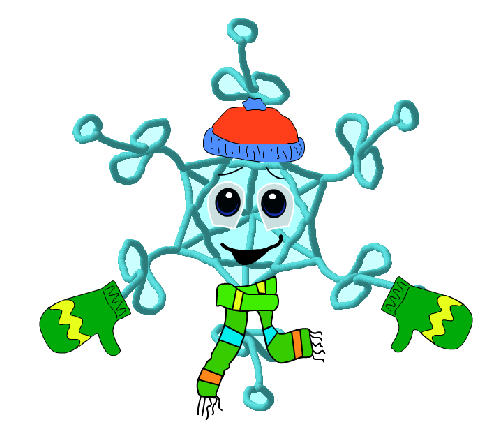
Students draw a snowflake and write a story about the snowflake's journey from its birth in the sky to its life on Earth.
Engage
Read Snowflake Bentley to your students. This Caldecott-winning story tells the story of Wilson Bentley, who was fascinated by snowflakes as a boy and was the first person who captured a photograph of a snowflake. He was also the one to claim that "no one design was ever repeated" after taking hundreds of pictures of snowflakes over the course of his life.
Look at images of snowflakes, and ask students to describe how these snowflakes are similar. Be sure they notice that all snowflakes have a hexagonal, or 6-sided, structure.
Assign a blank project to your students and ask students to design their own unique snowflake. Students can use the Paintbrush tool to quickly paint a 6-sided symmetrical snowflake.
While it is hard for students at this age to conceptualize that all snowflakes are different, having students draw several flakes with the symmetry tool and seeing how they are all unique, makes it a bit easier.
Create
To help students come up with ideas for their story, have them use the skills they learned designing their first 6-sided snowflakes to create a main character for their story about the snowflake's journey to and on Earth.
Students can convert their painted artwork into a sticker to make it easier to use on multiple pages. Once it is a sticker, it can be copied and pasted on other pages, resized and even flipped or rotated as needed.
Before they begin writing, haves students choose a geographical area where the snowflake will fall and the weather conditions that will determine how long the snowflake will live. Other questions you might have them consider:
- What character traits does the snowflake have?
- Does the snowflake have any friends that go on the adventure?
- What winter activities does the snowflake participate in?
Students can use this organizer to write a first draft of their story. For example, you might have them identify how the snowflake was formed, two activities it participated in, and how it melted.
Students can use their snowflake image and add additional pages for each diary entry. They can use the Text tool to add a box where they can type each section of the story. They can use the tools on the Paint panel to design backgrounds and add additional artwork.
Share
If students are going to create printed books, they can print each page as a full-size image and bind with construction paper covers. If the books are four-page projects with a cover, beginning, middle, and end; students can print the projects as four-page foldable booklets.
If students will be publishing the stories online, have them record narration to each page.
Assessment
This project works great as a performance task you can use to evaluate students' understanding of how a snowflake is formed as well as their understanding of the climate conditions necessary for snowflake survival.
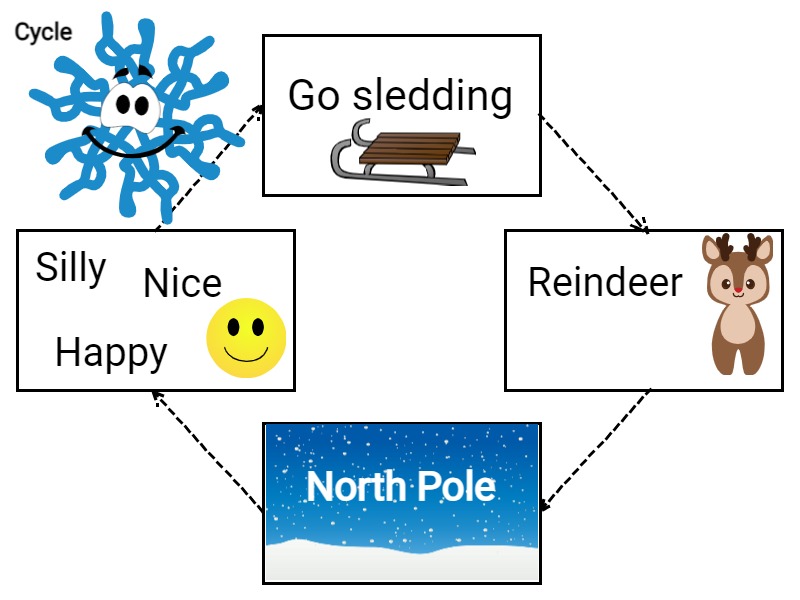
During the process, you can easily evaluate student understanding from the cycle graphic organizer. Having students turn in their narrative writing and storyboards prior to creating the story will help you ensure that they are on the right track.
The final product, whether it ends up as an eBook, animation, or video biography provides an opportunity for summative assessment. You may also want to include soft skills like teamwork, responsibility, organization, and problem solving as part of this final assessment.
Resources
Mary McKenna Siddals. Millions of Snowflakes. ISBN: 0395715318
Jacqueline Briggs Martin. Snowflake Bentley. ISBN: 0547248296
Kenneth Libbrecht. The Little Book of Snowflakes.
Science News for Students: How do snowflakes form?
Standards
Common Core Standards for English Language Arts
CCSS.ELA-LITERACY.W.2.3
Write narratives in which they recount a well-elaborated event or short sequence of events, include details to describe actions, thoughts, and feelings, use temporal words to signal event order, and provide a sense of closure.
CCSS.ELA-LITERACY.W.3.3
Write narratives to develop real or imagined experiences or events using effective technique, descriptive details, and clear event sequences.
CCSS.ELA-LITERACY.W.3.3.A
Establish a situation and introduce a narrator and/or characters; organize an event sequence that unfolds naturally.
CCSS.ELA-LITERACY.W.3.3.B
Use dialogue and descriptions of actions, thoughts, and feelings to develop experiences and events or show the response of characters to situations.
CCSS.ELA-LITERACY.W.3.3.C
Use temporal words and phrases to signal event order.
CCSS.ELA-LITERACY.W.3.3.D
Provide a sense of closure.
Next Generation Science Standards
2-ESS2-3
Obtain information to identify where water is found on Earth and that it can be solid or liquid.
2-PS1-4
Construct an argument with evidence that some changes caused by heating or cooling can be reversed and some cannot.
3-ESS2-2
Obtain and combine information to describe climates in different regions of the world.
3-PS2-2
Make observations and/or measurements of an object's motion to provide evidence that a pattern can be used to predict future motion.