
Halloween writing projects to inspire elementary learners
It’s that time of year when students can’t stop talking about candy, costumes, parties, candy, pumpkins, decorations, and... more candy. Capitalize on student excitement about this fun holiday with these Halloween-themed writing projects that engage them in narrative, informational, and argument writing.
Here are five ideas that can be easily created from a blank page or assigned from Wixie's Curriculum Activities or Design Templates library.
Create Concrete poems
Unlock the power of expression with concrete poems, where words shape themselves into the essence of the topic. Challenge students to craft Halloween-themed verses. Have students add each phrase or stanza in a text box, ready to be moved and rotated into a fitting Halloween shape.
Design how-to guides for Halloween activities
Many students already turn to YouTube for video tutorials to learn new skills. Ask students to combine simple sentences with illustrations or videos to communicate a process and build organization and sequencing skills clearly.
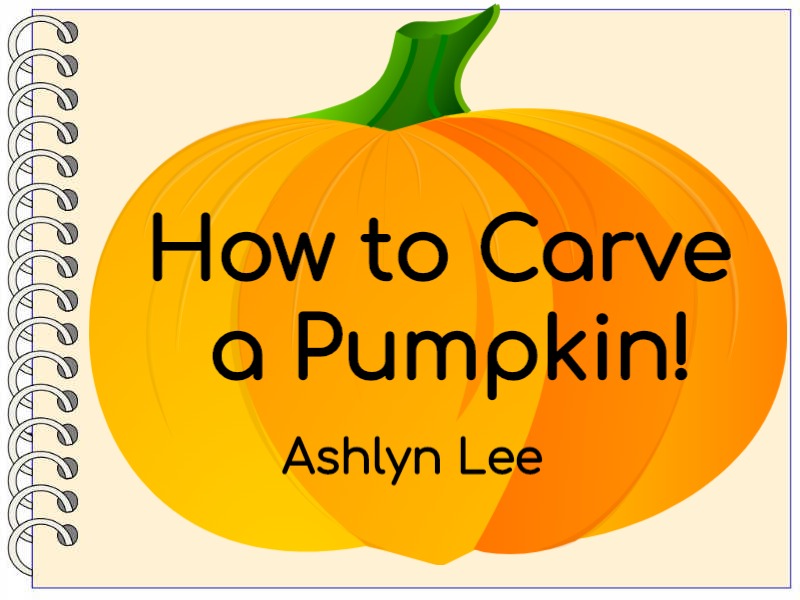
Give how-to writing a Halloween spin by asking students to create how-to guides for their favorite Halloween activities, such as:
- carving cool pumpkins,
- applying scary makeup,
- cooking Halloween treats, or
- creating creepy crafts.
Students can get started with a blank template or use a Booklet template.
This four-page template includes a cover page and three additional pages containing a text box and room for a picture.
Retell a spooky story or write an original Halloween narrative
Your classroom library, no doubt, has a Halloween section already. With so many fun Halloween picture books and stories like In a Dark, Dark Wood by Ruth Ware, it is easy to find one your class can retell or even adapt.
If you are working with emerging writers, you may want to focus on retelling stories. Young learners can use the Room on the Broom activity to have students retell Julia Donaldson’s fun story by dragging objects and recording their voices.
Older students can start blank projects or use a Halloween book template to write and illustrate their own spooky stories. If students aren’t ready to write from scratch, give them prompts like:
- In the dark, dark woods...
- When I went trick-or-treating with my friends....
- I looked out my window to find an enormous pumpkin…
Craft a fictitious interview with Halloween objects
Have students practice personification and create a fictitious interview with a Halloween character, object, or artifact. Choosing an object or character will help them connect to a point of view and consider the questions before they craft them. You may even have students start with an empathy map template to help students understand and personify their interviewee.
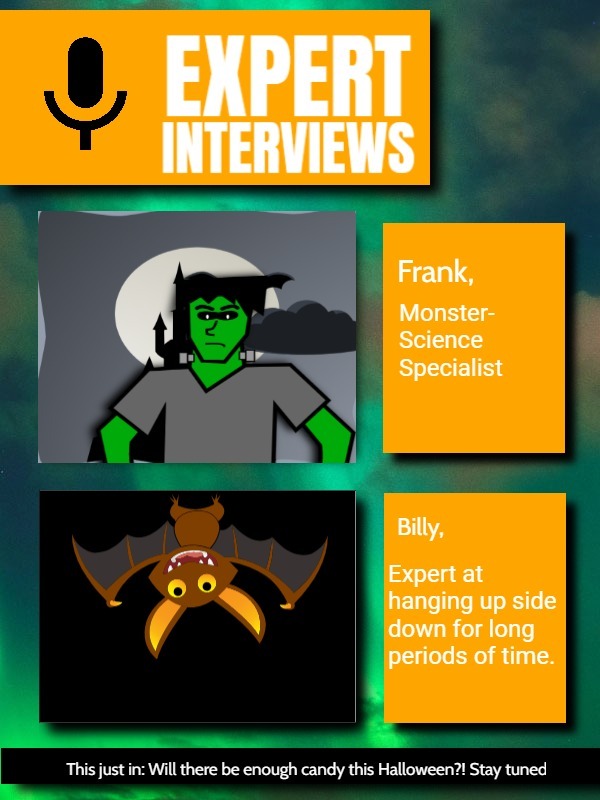
Have students use the authoring tools to create a page for each question and answer. Students can add art for each character or object, along with text boxes and thought bubbles, or even voice narration. Students could also dress up in character and capture interview responses using video.
Promote safety with a Halloween public service announcement
Have students combine images, voice narration, and video to raise awareness for a fun yet safe trick-or-treating experience. PSA projects are a great way to provide students with an authentic context for practicing and applying persuasive writing skills.
A short PSA targeted at a particular audience also encourages students to focus on writing organization, voice, and word choice. Because student work addresses safety issues relevant to their schoolmates and friends, be sure to publish their work in print in school hallways as well as on your school website. You might even consider sending them to your local access television station to give student work a real-world audience and clearly demonstrate the value of their effort.
Here's to your Halloween authors!
 Effective Integration
 Instructional Design
 Learning Strategies
 Literacy
 Month-by-Month
 Product Ideas
 STEM/STEAM
 Share and Showcase
 Updates
 User Management